
He Injected Himself With Enzymatically Purified Pig Brains
He thinks you should try it too.

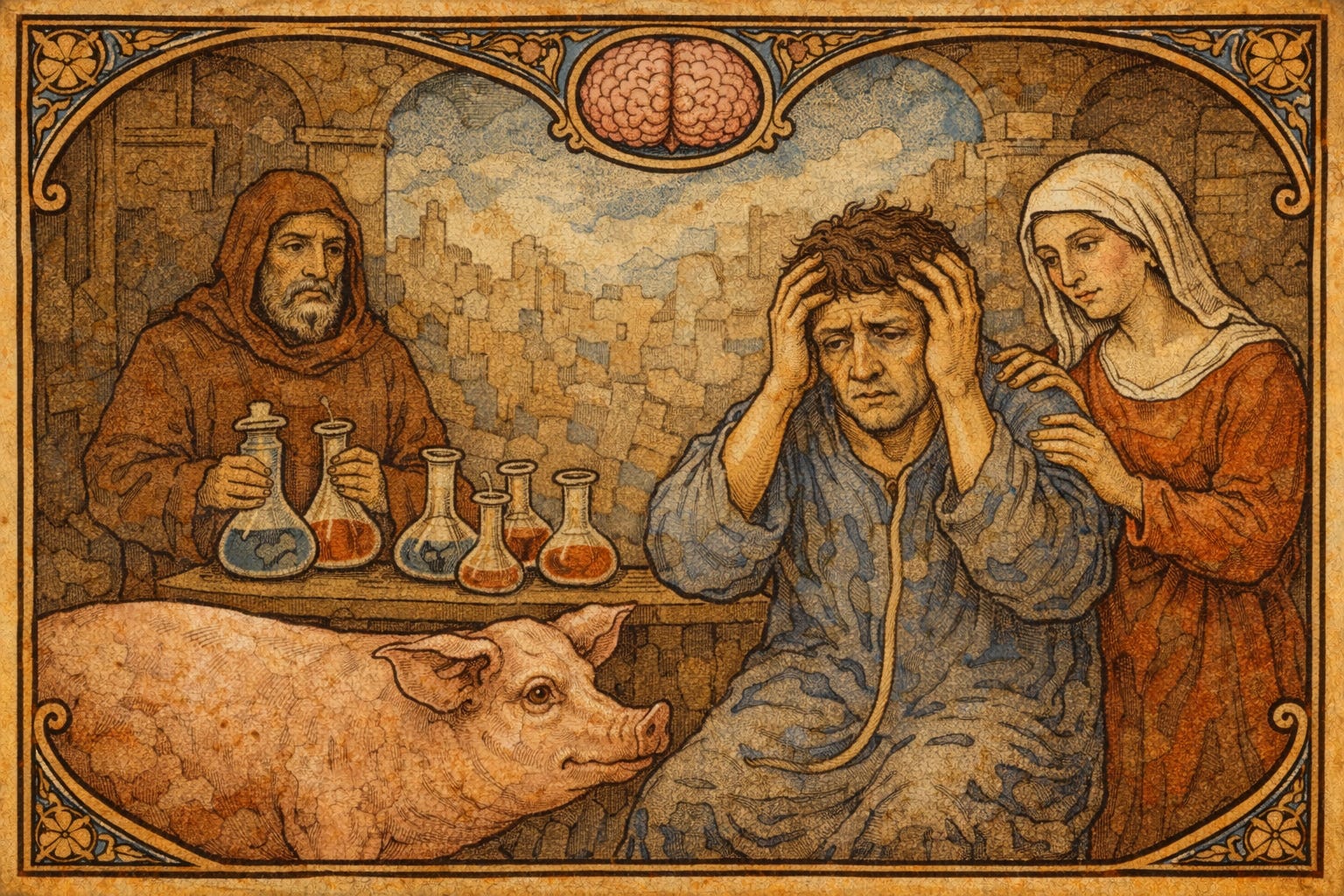
I met Adrian in a niche online community dedicated to cerebrolysin– a mix of peptides distilled from porcine brain tissue. In a thread simply titled “Cerebrolysin helped depression” the 37 year old personal trainer shared his story. “I was experiencing a sudden onset of severe anxiety and depression. I was seriously suicidal for the first time in forever, and I was ready to completely give up on my life after 2-3 months like this.” Cerebrolysin is prescribed in the former Soviet bloc and Asia as a treatment for dementia, stroke and TBI. It never gained approval in the US, but online communities have resurrected it as a neurological panacea. Modern biohackers see broad applications— clearing brain fog, improving memory, even curing depression. In Georgia, where Adrian lives, access to low cost clinics could take months— and he was already at rock bottom. I reached out to Adrian to understand how he settled on using a decades-old oddity of a drug.
“I first learned of cerebrolysin from a Youtuber by the name of Leo and Longevity. I’d found his page when my interest in neurology began, and he talked about cerebrolysin quite favorably.” Leo is one voice in a crowded field aimed at those seeking physical and cognitive enhancement. Biohacking evangelists abound: Huberman, Attia, Bryan Johnson, ‘Vigorous Steve.’ And don’t let the WWE-style moniker fool you, Vigorous Steve has published multiple cerebrolysin deep dives and cites more peer-reviewed research than most in the space. In contrast, Bryan Johnson’s recent clip injecting cerebrolysin into his glute while espousing its benefits has garnered 2M+ views. For better or for worse, these creators multiply awareness and fuel demand for a wide range of compounds. The monetization strategy of choice is “Affiliate Sales” for creators in this space— a 5%-10% finder’s fee for sending loyal viewers to an affiliated distributor. In an industry with powerful compounds and limited human safety data, affiliate sales could be causing appreciable harm. A symbiotic “grey market” has flourished, connecting foreign pharmaceutical wholesalers with eager bio-tinkerers. Most of these drugs are labeled “for Research Use Only.” Hence why some in the biohacking community refer to themselves as “lab rats”— though this is becoming passé.

The influencer pipeline is funneling lab rats into grey markets while rising insurance premiums, drug costs, and wait times push patients away from traditional options. Anyone who has tried to find an in-network urgent care on a Sunday has been radicalized. Anyone who has paid full price for a drug not covered by insurance has been radicalized. Since 1985, drug prices have increased three times faster than inflation.[1]
Adrian was in a desperate state of mind– accepting the risks of shipping unlabeled vials, ampules, and powders across international borders. Rather than testing every mysterious powder that gets intercepted, Customs forwards a seizure letter saying they’re keeping the “HGH” for 30 days, then destroying it. In a truly Kafkaesque twist you can incriminate yourself by filling out the attached form and admitting to breaking the law. Wise recipients decline to sign the trap paperwork. Biohackers take solace in plausible deniability– who’s to say someone didn’t steal your identity to order the mysterious powder? In grey market forums would-be ‘researchers’ report having packages seized and consequently losing their Global Entry trusted traveler status. This process is extrajudicial, no pesky due process to help you. To many the benefits outweigh the risks. A credit card payment to a logistics company in Kazakhstan is all it took for the nondescript package to arrive at Adrian’s front door. It took ten days. The median wait time to be seen by a psychiatrist in the US is currently 67 days.[2]
Adrian had been delving into pharmacology since he was a teenager– steroids, research chemicals, years of self-experimentation. He was armed with knowledge– scaffolded by online communities, forums, and shared protocols. By the time severe anxiety hit, he’d developed his own pharmaceutical logic, one that bypassed doctors entirely. He approached it methodically; administering 5mL daily for 10 days. Unlike other peptides that can be administered with a tiny insulin needle, cerebrolysin is injected in larger volumes– directly into muscle tissue. He was aware that effects could vary widely and that no guarantees existed. “Neurology demands nuance, and I think that’s a part of what makes it so exciting to me.” It was time for Adrian to break the skin.
After the first dose, he never had another panic attack. “My anxiety completely washed away,” he told me. “It could only be described as miraculous.” Adrian attributes his recovery to cerebrolysin “potentiating neuroplastic/neurogenic cascades”—a plausible hypothesis considering the neuroplastic mechanism psilocybin and ketamine produce in patients with treatment-resistant depression.[3,4]
The truth is no one knows how cerebrolysin works. It’s thought to contain between 638 and 14,000 unique peptides. That’s a truly impressive error bar. Research conflicts on whether it even contains neurotrophic factors—the signaling molecules which promote survival and growth of neurons. Even the Wikipedia article simply states it “can” contain them. The study showing BDNF increases was conducted in Alzheimer’s patients; healthy participants have never been studied. If Adrian’s mood disorder was related to depleted neurotrophic factors, cerebrolysin may have jumpstarted his brain’s repair mechanisms. I asked Adrian if he'd do it again. He didn't hesitate:
"I don’t think I’d be alive today if it weren’t for cerebrolysin.”
There is a theory of mind called the Bayesian Brain Hypothesis that proposes that all human behavior is an attempt to reduce uncertainty. For some, that means waiting for FDA approval. For others, it means ordering from Kazakhstan. How you feel about Adrian’s drug usage will depend on your tolerance for uncertainty. Many will hear “It’s not FDA approved” and consider no further. The biohacking realm can empower those who research diligently and resist overconfidence. But how do you tell if you’re a visionary or a fool? The healthcare system that failed Adrian won’t answer. Neither will the influencers collecting affiliate fees. I don’t pretend to know the answer.
Adrian’s experience is singular. Some users report dramatic benefits; others say it’s snake oil; a small but vocal group have reported persistent neuropathic pain in their hands.[5] The science hints at cerebral stimulation, yet decades of research still leave room for doubt. And maybe that is part of cerebrolysin’s appeal: it lives in the space between evidence and hope, where one brain seeks certainty in the extracted essence of another.